Between the Lines
Insights for professionals who think deeply about their careers.

A Summer Journal — Field Notes on Job Searching When Everyone Else Has Checked Out
Paris, end of June. My friend is enjoying her iced coffee, telling me she really needs to start looking for a new job. "I've been procrastinating. I just don't know where to start." I take a sip. "Well," I say. "Let's get to work.”
Paris, end of June. My smoked ice tea is delicious, and my friend is telling me that she really needs to start looking for a new job.
"I’ve been procrastinating. I just don't know where to start," she says.
I take a sip. "Well," I say. "Let’s get to work."
What I told her is what I'd tell anyone sitting across from me this summer, actively searching, quietly thinking about it, or pretending they'll start in September.
1. Summer is not the wrong time. It's actually a great time.
Everyone assumes hiring slows down in summer, that there is no point applying. And yes hiring does slow down, a little. But here's what that actually means for you: less noise. Fewer applicants. More room to be noticed. So show up intentionally, and with more focus than everyone who decided to wait until September.
2. Slow down before you speed up.
The biggest mistake I see is wanting to start by doing. Updating the resume, applying, optimizing LinkedIn. Before any of that: sit with the question nobody wants to sit with. What do I actually want? Summer gives you the space to answer that honestly. A slower season is an invitation to think before you act. Use it. Start a journal, mind map, set goals.
3. Your values are your compass. Find them before you move.
The people who struggle most in career transitions are the ones who start with the document and work backward to the person. Again, don’t start by doing. Start with you and what matters most to you, not what should matter, not what mattered five years ago. That answer is your compass for everything that follows. Without it, you're navigating without a map. Know your values, what you are seeking, but also what you do not want.
4. Tell everyone. Especially at the July 4th tailgate.
Several of my clients have found their next opportunity not through an application, but through an unfiltered conversation at a barbecue, a pool party, or a holiday weekend gathering. People cannot help you if they don't know you're looking. You don't have to make it awkward or heavy. Say it simply, say it lightly (but clearly): "I'm exploring what's next for me. If you hear of anything, I'd love to know." Then pass the potato salad and enjoy the fireworks.
5. Collect the warmth. Store it for winter.
Summer does something to people. More sunlight. More social energy. More moments where you feel, briefly, like the best version of yourself.
That feeling is not incidental. It's fuel.
Use this season to build something that will sustain you when the days get shorter and the search gets harder. Build a network and a support system, genuine relationships with people who know what you're looking for and want to help.
The energy you generate this summer is something you get to carry with you. Collect it deliberately. You will need it in the fall.
6. Use the slower pace to build, not just apply.
Take the course you've been wanting to take. Go to that networking event. Have the coffee with the person you've been meaning to connect with for six months. The people who show up in September having spent the summer growing, not just applying, are a different kind of candidate. They’re clearer and more energized.
7. You don't have to do this alone.
This is the one my friend needed most. She'd been sitting with this goal for months; turning it over privately, getting more and more stuck. The moment she said it out loud to someone who could actually help, her energy shifted.
A coach. A trusted friend. An app that asks you the right questions when no one else is around to ask them. Whatever form your support takes — find it before September. The search is hard enough without doing it in isolation.
Sophie Leroi is a career coach, co-founder of Space Between, and the person who will absolutely talk about your career pivot over a café crème in Paris if you let her, or on Zoom if that’s easier. Book a free consultation at spacebetween.ai or start with the Res/You/Me app.

Mom, ChatGPT Ate My Words
An action without a reason is dangerous in itself — which, ironically, is how I feel about a lot of interaction with AI in the first place. Here's my attempt to provide some of that why.
Asking why behind the AI advice you hear every day
10 min read
Summary: A response to the most common AI advice — the "don'ts" — arguing that the advice is right but incomplete without the reasoning behind it. Working through seven common warnings (personal advice, verification, vague prompts, copy-pasting output, agentic chains, augmentation vs. replacement, and human oversight), the piece draws on the author's own experience building a career-development app to argue that every choice about AI, in either direction, deserves a why.
There's no shortage of advice about how to use AI. I find a lot of it comes in the shape of "don't." Don't trust it. Don't paste into it. Don't believe it. Don't rely on it. Etcetera, etcetera.
I think there's some validity to those statements. What's missing is the why behind them — and an action without a reason is dangerous in itself, which, ironically, is how I feel about a lot of interaction with AI in the first place.
So here's my attempt to provide some of that why. These are my own interpretations, drawn from my own work and experience — take them for what they're worth.
"Don't ask AI for important personal advice."
Right out of the box, AI doesn't know you. It doesn't know your preferences. It doesn't know your values. It doesn't know what you like, what you hate — and yet it will talk to you like it does. It fills in the gaps to create a story that makes sense and a response that seems justifiable. And when a model doesn't know what you want, the assumption it reaches for most often is that you want to be told something — and, more importantly, that it wants to support your decision, or your statement, or whatever it is you're talking about.
I learned this the expensive way. Early on, working on a feature, before I had a better sense of how to collaborate with a model, I thought I had a pretty good idea. I gave my thoughts, took the responses, and worked through it — and it was probably a week of beating my head into the desk before I realized I'd gotten sucked into a dead end, working off an approach built partly out of the information the model had given me. Every response along the way felt supportive. None of them pushed back. That's the trap: not one bad answer you catch in the moment, but a week of gentle agreement leading you somewhere that doesn't go anywhere.
It's fine to ask the questions. But it's important to build a framework of information that lets the AI actually answer the question you're asking. That framework has to be structured so the information carries meaning. You can't just list off fifty things about yourself and call it a day. You have to explain why those fifty things matter, and why you put them in the order you did. That why is what turns a pile of facts into a concept the model can work with.
"Don't trust the output — verify everything."
Fine in spirit, but ultimately useless in practice, because nobody has the time or space to verify everything. And if you could, you wouldn't need the tool in the first place.
My approach is to verify the things I might say in front of other people. The moment a claim leaves my head and heads somewhere someone else will see and interpret and evaluate, it stops being a passing thought and becomes something I need to put my name behind. That's my line. Verify what you'd be willing to stand behind in public, and let the low-stakes stuff stay low-stakes.
But the deeper reason to keep a line like that isn't really about any one claim. It's about the information, sure — but it's about exercising the habits you should be exercising with humans. Skepticism is a habit, and habits don't stay in the chat window. It's the same reason I say please and thank you to a model: not for its sake, but because how I practice being in one place is how I end up being everywhere. Without some kind of line, I think there's a bit of a descent into AI madness. 🙃
"Don't give it vague prompts — give it context."
This might be the single most repeated piece of AI advice that exists. Every guide says it. But there aren't enough good examples of what "context" actually looks like. So here's how I think about it, using something I actually want for my birthday: things from Expedition 33.
Rung one — say what you want. "I like games" is wildly open. Board games? Video games? Tabletop? The X Games? There's nothing to act on. Compare that to: "I want art and desktop figurines from Expedition 33." Now there's a real target instead of a guess.
Rung two — say what you want, with examples (kept broad). Building on rung one: "I want figurines and art from Expedition 33, specifically characters and montages." Those examples guide without trapping. But narrow the example too far — "I want things like Esquie, and that's it" — and it becomes the anchor. The model, especially a smaller or faster one, drags everything toward that single point instead of the category you meant. (Broad example: good. "I specifically want Esquie": the wrong kind of specific — though it is the right choice, because I genuinely want an Esquie plushie.)
Rung three — add what you don't want, with the why. "I don't want Expedition 33, the game." On its own that sounds bizarre — it's a birthday list made of Expedition 33 — right up until: "because I already have a copy." The reason is what turns a confusing exclusion into useful direction.
Rung four — the floor. Take rung three and strip the "because" off. Just "I don't want the game." No reason, no direction — a wall with nothing explaining it. That's the worst prompt youncan write.
*The through-line down all four rungs: the more you steer by saying what you do want, the better, and the moment you lean on "don't," you'd better bring the why* — or you've built a wall and left the model, or the gift-giver, standing in front of it with no idea why it's there.
"Don't just copy-paste raw AI output."
Just don't.
There's a difference between saying "I understand A, B, C, and D, and this is what I want to do with them" versus "pick letters for me and make something that sounds good." One is direction. The other is outsourcing the understanding itself.
When content gets generated and nobody checks it, that's how you end up with prompt responses printed in newspapers. People touting "I generated this content" feel so shallow to me. Cool. I breathed today. I ate food today.
When AI does the writing, you lose three things: ownership, critical thinking, and creativity.
I've run into this in my own app. The first version of a feature I created did things backwards — it made the user the editor of the AI's content, instead of the other way around. I should be the editor, and the user should be the author. It took real work to break the process apart so the user's language is the overwhelming majority of the words, and the AI is just stitching and tidying.
I typically draw the line at prescription versus question. Is the model telling me what I should do, handing me a finished statement, changing my words for me? That's prescription, and I refuse it. Or is it asking, reflecting, handing my own material back to me? That's a question, and that's the version worth keeping. There's a place for a little of the former — light help with wording, because being a weak writer shouldn't keep anyone from applying or being heard — but it stays the exception, never the default.
"Make everything agentic! "
Actually, don't.
It's a fascinating concept, but it comes with hidden dangers — and a level of chaos that, in my opinion, hasn't been thought out well enough before being slammed into every piece of software we touch on a daily basis. Right now it seems like people are just slapping a bunch of tools together and saying, "gee, I hope this works." Is that really how we want things to work, though? There's absolutely a time and a place for these agentic models, but it has to be a deliberate choice. And honestly, there's just as much deliberate choice in not using it — the same way there's a deliberate choice to add or exclude AI in the first place.
An agentic chain is like a weird game of telephone. You talk to your neighbor, your neighbor passes the message to the person in front of you, and that person responds to you — but you never get to talk to them directly. Just food for thought: if you've ever flipped on "thinking" mode in a chat (which, these days, is often on by default), you've already engaged in an agentic chain. The moment that toggle is switched, there's an interpretive step sitting between you and the answer. And if you're not paying attention to the fact that it's happening, it can get genuinely confusing what's actually going on.
Let's keep the telephone game metaphor going. If you have multiple people playing, you know how the story goes — the more people that play, the more garbled the message gets. And that final person, more often than not, gives back something completely nonsensical compared to the original statement. It's definitely really cool when the original makes it all the way around. But that's not the norm. That's the game we're playing when we set up agentic systems — and the math backs it up. In a multi-step chain, errors don't add up, they multiply. A five-step process that's 95% right at each step is only right about three-quarters of the time by the end. That's quiet chaos, and it's really hard to monitor. When you run a regular function and it doesn't work right, usually it's handled, and if not, the software screams at you. In these chains, that error in thinking just gets passed from one step to the next.
So with that knowledge, I personally choose to keep things inspectable — giving myself visibility into each step, so I can observe what's happening throughout.
For what it's worth: this has been my preference for a while, and based on where the industry has ended up, it seems like I made the right choice.
"Use AI to augment people, not replace them."
As author Joanna Maciejewska put it: we wanted AI to handle the laundry and the dishes so we could go create art — not the other way around.
But what we see is a loss of entry-level jobs and a replacement for creativity and critical thinking. It's just that easy to use it incorrectly. So what does it mean to use it in such a way that you can do more than you could by yourself?
My app is a good example. On my own, it never would have gotten done. But because I had tools available that augmented my ability and helped translate my thoughts and ideas, I was able to make something I think is meaningful. Every concept and idea in it came from my head — the tools let me explore them, refine them, test them, and build them. Honestly, the tools I used only ever worked well when I understood what I was asking for. When I didn't have a clear concept, or did a hand-wave and said "make this for me," at best the result was mediocre — but typically it was just far from what I wanted. And on top of that, as I was building this thing — which is honestly very personal — there's no way the model can replicate my lived experience.
Automation processes you into an output. Augmentation makes you more than you were on your own. So whatever end you have in mind for what you're doing, just stop and consider how AI is getting you to that end.
"Keep a human in the loop."
Part of being human is being witnessed. Without that, do we really exist?
A human cares, and AI emulates caring. I won't pretend the emulation isn't getting better — it is, and quickly. But when you sit across from a person, they're not just reading or hearing your words. They're observing your face, interpreting your tone, and the pause before you answer — maybe reading the kind of day you're having. Emulated caring optimizes for making you feel cared for. Actual caring just connects with you on a human level.
That's why the human in the loop exists. Not rubber-stamping the output — but using the experience of being alive to understand what another person is feeling and living.
So there you have it. A bunch of exposition on a bunch of statements you might be hearing on a daily basis. A lot of this was mostly my opinion, but I've tried to base it on everything I've read, written, and built.
I don't think AI is good or bad. I think it takes the shape of the people that put it in place. And I also think that at every step along the way, each choice deserves a why.
For some of you, you're probably happier with no AI in the world. For some of you, you're glad to see it added to everything. But I think most people land in the middle. And in that middle space, where we're bombarded with do's and don'ts, asking why can go a really long way.
Standards, Averages, and "Good Enough"
AI is fantastic at pattern recognition. But it has to have enough information to find the pattern, which means a person has to give it enough information in the first place. And that's the hard part.
Speaking from past experience, I've had moments in my life where, rather than being responsible and getting a bowl and spoon, I would simply take the gallon of ice cream and a spoon and have more than I probably should have. In the moment, it was fine. But after the fact — usually a couple hours after the fact — you get the idea. Sometimes it's just hard to stop, especially if there's nobody there to stop you.
There's a lot of things in life like that. It could be ice cream. It could be scrolling Instagram. It could be Netflix autoplaying to the next episode, and you just roll on with it.
Another place I see that same pitfall is AI. I very clearly see the appeal of putting text into an input and getting an immediate response back from something that sounds very human and is willing to support us and tell us how wonderful our ideas are. And why wouldn't we want to consume as much of that as possible? If we're in a rough place in life, we're not getting the support we need, whatever that looks like — but we've got that one thing that's always in our corner. It's gonna be really hard to say no to that.
---
Much like most people, I have a very basic understanding of the way AI makes its choices — all the calculations that say this is likely the next word and why it's the next word. But for a moment, I don't even want to think about the math side of it. I just want to consider something I observe in the world.
AI can only really train on what people have talked about. And if you scroll on LinkedIn, you see the dichotomy of people who have an opinion about something — this is what I did to get a job, and you can too, versus don't do this because of this or that. I think it's really important to remember: these people are speaking from experience, but specifically their own personal experience.
When you get in a room with somebody and start having a conversation, that's a completely unique moment — affected by the smile on your face, the shirt you wear, the deodorant you put on that day, the sandwich the other person had for lunch, how much sleep they got, all these little things adding up. So it's going to be the things that people actually report that the models use.
So if we take this framing and look at resumes — you've got somebody who says, I did these things to my resume, I stuffed keywords, I changed the formatting, etcetera. You'll get so many different combinations, but it's relevant to the time and place and person. So it's not appropriate to assume that one answer is the correct answer.
And even further still, I would venture to say that people just do the right thing, and maybe don't talk about it, because they're busy living their lives and just doing the thing and not telling the whole world about it.
Think about it this way. A lot of what shows up on a place like LinkedIn is posturing — people writing to be visible, for whatever reason. There are a few posts that are genuinely "I'm sharing this because I think it's cool, and I want other people to know." So if you're not the kind of person who postures — if you just show up, do your work, and do it well — your best insights are happening person to person, at meetups, at conferences, in conversations that never get written down. And the models, as I understand it, were trained on a large, curated part of the internet. Which means those unrecorded conversations never make it in. The keen insights, the stuff actually steering toward the next thing, isn't available to the model at all. What's left is the generally agreed, the already-assumed-correct — with the most variability landing exactly where things are newest or most in conflict.
So if AI is trained on the average, how can you really get at the right thing without doing a little bit of work?
A real "good enough" is something based on standards. The less standards that exist in the space you're addressing, the less credibility "good enough" has. Without any standards behind it at all, "good enough" is three kids in a trench coat pretending to be an adult.
Think about a car. You've got the totaled one — wrecked, undrivable. That's your zero. You've got the one that's properly cared for — serviced on schedule, oil changed, tires rotated, running the way it should. New off the lot, that's your hundred. And then there's "good enough": the car you keep driving with the maintenance light on. You skip the oil change, or you patch it instead of fixing it. It drives fine today. But the cost of ignoring all that doesn't show up until much later, when it's a much bigger problem with a much larger price tag attached.
It's generally agreed that AI isn't really coming up with new ideas. And because of that, it's not going to magically define a standard either — it can't conjure something that doesn't already exist in a given space. It's leveraging the knowledge that already exists for that space, so it falls back on the quality of standards in play there. And if the answer to "what are the standards" is "not a lot," then in addition to engaging with the prompt, you have to be really clear about what your own personal standards are — because if you don't name them, AI is just going to default to that magical average of information that exists in the training data.
I think AI tools have the potential to do really good things. But I don't think testing and quality-checking is the user's responsibility. Not really. Somebody shows up to use a tool, and they expect it to work well — they expect they've been handed something that does what it claims it will do. The responsibility falls entirely on the developer, the product team, everybody backing the idea. Companies need to slow down and actually think about what they're putting out.
That said — users still need to go into this with their eyes open. Going in eyes open means that when you get a response, you're willing to question whether it's just what you want to hear, or something that's valid and based in reality. If you don't think about any of this, you're going to get that average answer, built on some good and some bad, and you won't know which parts are which.
AI is a brand-new tool — very powerful when used correctly, very dangerous when used incorrectly. When I go onto Claude or Gemini, there's nothing there outside of the guardrail responses that show up if I ask something in violation of them. The tools just very happily respond. Hallucinations are still a thing — they're just hidden better now. Search and source citations help, in that they give you something to actually go check — but they don't mean the problem's solved. Citing a source isn't the same as the source being right. There's a lot stated as matter of fact, and that's the part that's dangerous. But there's nothing that trains the user how to engage with these interfaces in a way that safeguards themselves. And that's the problem: it gets promoted as this huge, amazing thing, and almost nobody talks about where it falls short — or whether we even got to opt into using it in the first place. (Looking at you, Google.)
On the developer side — and this is coming from my own personal observations — I think there's been a lot of relying on the user to evaluate the quality. I think of OpenAI in its early days of ChatGPT, where it would present two different answers and people would pick which one read better to them. There are two things going on there: OpenAI was using users to train the models, and the answers themselves weren't necessarily authoritative — it was simply "I like A better than B." But in the end, OpenAI didn't pay most of us. They just said, here's the thing, answer this question for us because it's really easy to answer. And guess what — people did. I did it. And even today, it still exists in some ways: thumbs up, thumbs down. It's information for the developers — "this was good," or "I didn't like this." Which means they can still keep shipping things quickly that live under the ruse of good enough, and quietly use those indicators to make corrections later.
I've had moments of this in my own app, and in some ways, I regret it. I think it's just a pitfall of being one person trying to build an idea. But I made an effort to understand and improve, which is all I think can be asked of anyone.
AI is fantastic at pattern recognition. But it has to have enough information to find the pattern, which means a person has to give it enough information in the first place. And that's the hard part.
But on the flip side, most people are prone to take the easy path, at least at first. There are a ton of reasons for that. Maybe you just really don't care. Maybe you don't have the energy. Maybe the thinking brings up past experiences that hurt. I could keep going, but you get the idea.
Something I've noticed in interacting with different AI tools, though, is that taking the easy path starts to leave you with an empty feeling inside after a while. You feel how little control you have, and how empty things sound or feel. And then you want to go back the other way — so you start putting in just a little bit of effort.
I think it takes a very self-aware and mentally healthier person to just dive into the hard things. And I don't think that's a place many people reside, especially these days. So much of the time, as far as I can tell, nobody has quite enough money, and it feels safer to stay where you are than to make a change. There's safety and familiarity in staying put.
But it takes a healthier person to be able to do this alone. With the right kind of support, the hard things become more accessible to everybody. Excavation isn't only for the self-aware few. It's for everyone. It should be for everyone. It shouldn't be a luxury.
The minute you put a gallon of ice cream in the freezer, it's there. And at any time, you could take the whole thing out.
It takes effort and discipline to only grab a bowl. And sometimes, for some people — like myself — it's better not to have the gallon in the freezer in the first place. You stick with just the occasional pint.
So whether we're talking about a gallon of ice cream, or an AI model that will tell you you're the most wonderful human being and all your choices are amazing — it's worth stopping and thinking about the conscious and unconscious choices we have to make on a daily basis, with all the different things that are now part of our lives, whether or not we asked for them.
So, as a parting thought: if you're going to get a gallon of ice cream, make sure you have some humans to share it with.
Your Resume Is Not a Record of Your Past. It's a Description of Your Future.
By Sophie Leroi & Michael Bocim
Let me say something that might feel uncomfortable at first.
The reason most resumes aren't convincing isn't poor formatting. It isn't weak bullet points. It isn't even a lack of experience.
It's that the person writing it doesn't yet know how to clearly and confidently articulate — in their own words — who they are professionally.
That's not a resume problem. That's a self-knowledge problem. And it's extraordinarily common.
The Resume Trap Most People Fall Into
Here's what typically happens when someone sits down to update their resume.
They open a blank document. They start listing jobs in reverse chronological order. They Google "good resume examples." They look at a few LinkedIn profiles of people with impressive titles. And slowly, without realizing it, they start to sound like someone else entirely.
The words become borrowed. The bullet points become generic. The professional summary — if they write one at all — reads like it could belong to anyone.
And then they wonder why their resume isn't landing.
The problem isn't the document. The problem is that they skipped the most important step: understanding themselves first.
What a Resume Actually Is
Here's the reframe that changes everything:
Your resume is not a record of your past jobs. It's a description of your strengths for your future.
Read that again.
Every line, every bullet point, every word you choose is an opportunity to say: here's who I am, here's what I bring, and here's why it's relevant here. It's not a chronological archive. It's a curated argument for why you are the right person for what comes next.
When you understand that, the whole exercise shifts. You stop asking "what did I do at that job?" and start asking "what does this experience reveal about who I am as a professional?"
That's a fundamentally different question. And it leads to a fundamentally different document.
Why Most People Skip the Most Important Step
Career transitions are hard. Job searches are stressful. When the pressure is on, most people go straight to the document because it feels productive. It feels like action.
But a resume built on a foundation of unclear self-knowledge is like building a house on sand. It might look fine from the outside — but it won't hold.
The most compelling resumes aren't the ones with the best formatting or the most impressive titles. They're the ones where you can feel the person behind the words. Where the language is specific, consistent, and unmistakably theirs. Where every line seems to say: I know exactly who I am and what I bring, and I'm not apologizing for it.
That clarity doesn't come from a template. It comes from doing the internal work first.
Three Principles for a Resume That Actually Sounds Like You
1. Lead with who you are, not just what you've done.
Your professional summary — those two or three lines at the top of your resume — is the most valuable real estate on the page. Most people waste it on a list of adjectives ("results-driven professional with 10 years of experience") that could describe literally anyone.
Use it differently. Use it to say something true and specific about who you are as a professional. What do you value? What kind of work brings out the best in you? What do you want someone to understand about you before they read another word?
That's your opening line.
2. Let your values show in your language.
Here's something most resume advice misses entirely: coherence. Not just coherence between your bullet points and your job description — but coherence between your inner sense of who you are and the words you use to describe your experience.
When those two things align, a resume feels cohesive rather than assembled. It feels like it was written by one person with a clear point of view, not pieced together from a dozen different templates.
The words you choose should echo what matters most to you. If you value impact, your bullet points should show impact. If you value collaboration, your language should reflect that. The resume is not separate from your values — it's an expression of them.
3. Coherence over comprehensiveness.
This is the hardest one to put into practice, because it requires leaving things out.
A resume that tells one clear story is more powerful than one that tries to include everything. Every line you add should pass a simple test: does this serve my narrative? Does it add something meaningful to my professional portrait? Or am I including it because I worked hard on it and I want it to count?
Not everything counts equally. And that's okay.
The most confident resumes are often the shortest ones — because they've made deliberate choices about what to include and what to leave out. That deliberateness is itself a signal to the reader.
Think of It Less Like Writing, More Like Transcribing
Here's the thing: if you've done the internal work first — if you've taken the time to understand your values, articulate your strengths, and shape your professional narrative — then your resume already exists.
Not on paper. In your head.
What you're doing when you write it isn't creating something from scratch. You're transcribing something you already know by heart.
That shift in mindset changes everything about how you approach the page. You're not staring at a blank document wondering what to say. You're translating something that already has integrity into a conventional format.
The thinking is already done. The resume is just the artifact.
A Question Worth Sitting With
Before you open your resume document, ask yourself this:
What would I want someone to understand about me before they even looked at my work history?
Whatever comes up — that's your starting point. Not your most recent job title. Not your longest tenure. Not your most impressive achievement.
The answer to that question is the thread that should run through every line of your resume. It's what makes a document feel cohesive. It's what makes a recruiter pause and think: I want to meet this person.
The Bottom Line
Most resume advice skips the most important step. It starts with the document and works backward to the person.
We think that's exactly backwards.
Start with yourself. Understand your values, your strengths, the narrative that's uniquely yours. And then — only then — open the document.
Because when you know who you are, the resume practically writes itself.
Ready to do the internal work first? Start with the Professional Compass on Res/You/Me — a guided reflection exercise that gives you the self-knowledge your resume has been missing.
Or if you'd rather work through it with a coach, book a free session with Sophie and we'll figure out what you're trying to say — and why it matters.

Go Lose Yourself — In the Best Way Possible
When you're in the process of undertaking a task, and you don't have a clear path through the middle section, you keep trying. You change your methods. You change your style. You change the language. To an extent, that's fine and perfectly normal. That's just part of existing in the world.
But if and when you keep failing, and you keep changing as a response to those failures, at what point do you stop being yourself? At what point do you forget why you're doing what you're doing?
It seems like there's too much in our everyday lives — and maybe even beyond — that pressures us to not be ourselves. There are so many reasons for this. Maybe your values don't align with the people you work with, but you don't get to speak up because then you're the bad guy. Maybe you're trying to get a match on a dating app, and you're saying the things you think somebody wants to hear. Maybe something that should fall into the category of kindness and compassion is something that's now political, and you don't know what to say about it. All of these different pieces push you to conform and slowly erase who you are.
Without the right tools, techniques, and people in your life — without anchors — how do you stay true to who you are? How do you keep showing up in the world that way?
When I write, I consider myself somewhat of a creative. I like wordplay. I like goofy analogies and metaphors. I like drawing connections between things that don't necessarily make sense simply because it's fun, and because it lets me engage with the world as myself.
In the course of my life, I've gone through times where I just don't know what to say. I don't know how to say what I want to say. In those moments, when I don't have the support I need, I tend to retreat. Tend to say less, soften more, stay quiet. Because quiet is safer.
I think there's a right way and a wrong way to lose yourself.
Honestly, I think Eminem got it the most correct. You find the goal you want, focus on it, stay true to yourself even when it gets hard, even when you struggle.
The alternative is losing yourself to a place that's a lot harder to come back from, because it's a direction you didn't choose. You succumb to it. You don't know how to answer when somebody asks you, what do you do for fun? You can't remember the last time that time passed because flow states aren't a thing anymore. You drift away from friends and connections. You find yourself in a very lonely and isolating place.
So go lose yourself, in the best way possible. Be a little chaos gremlin and write what you want to write. Say what you want to say. Be yourself. As long as it's you, as long as it's real.
Intentional Pressure: What Pottery Taught Me About Stretching Without Breaking
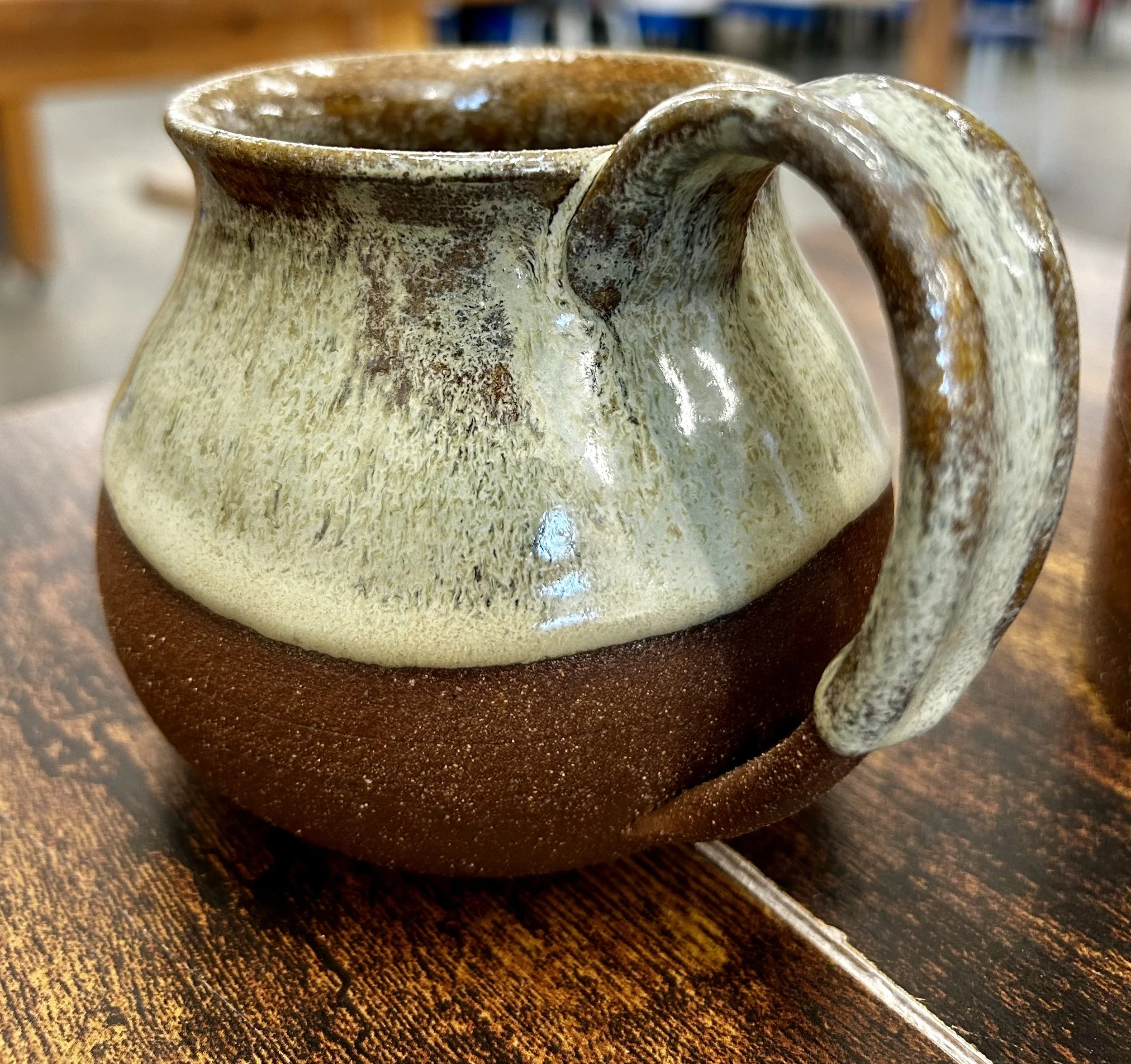
There's a crucial difference between productive discomfort — the stretch that builds new capability — and destructive stress that breaks rather than shapes. Pottery taught me the difference.
I was staring at what should have been a pretty vase with a round belly and a tall narrow neck, but it looked more like a wonky ball of clay. After weeks of successfully throwing mugs, bowls, and yes… even plates, I had decided to challenge myself with something more creatively complex and demanding. That day, our teacher had brought this beautiful bottle vase to the studio, and I decided that would be my next challenge.
After a demo and some 1:1 coaching, my hands were trying to partner with the clay to get to the desired outcome. I was following each step carefully, trying to remember everything I had just seen and learned, and slowly but surely the frustration started building in my chest. This was hard. This was uncomfortable. This was not going to an easy 20 minute throwing session. This was about to take an entire hour… Something about the struggle felt familiar from my work as a coach —I was watching someone (myself) navigate the messy, vulnerable process of growth.
The Discomfort of Growth
Those first attempts at pottery were humbling in ways I hadn't expected. My hands and my brain, usually confident in guiding others through career transitions, felt uncertain against the clay. I was reminded of the countless clients who have sat across from me, describing their resistance to taking on a challenging new project or considering a role that felt just out of reach. There's something deeply human about our instinct to stay where we feel competent, where we know we can succeed.
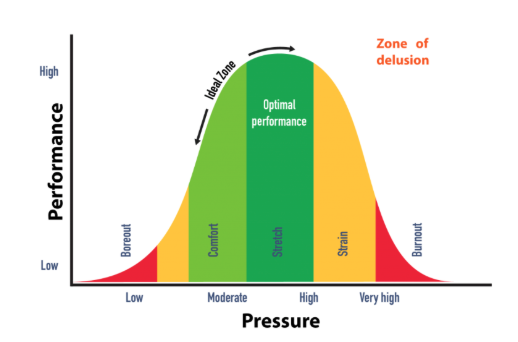
But here's what both pottery and career development have taught me: there's a crucial difference between productive discomfort and destructive stress. Productive discomfort is that feeling when you're stretching just beyond your current capabilities—your hands are learning new muscle memory, your brain is forming new neural pathways. Destructive stress is when you're forcing outcomes, fighting against your natural limitations, or pushing so hard that you're likely to break something (or yourself) in the process. In other words, if the challenge becomes too much, we stop functioning in positive and supportive ways.
This reminded me of a graph I printed out years ago when I started coaching clients that’s been up on my wall in my office for all this time: the optimal tension curve, or stress performance curve:
The Paradox of Endless Possibilities
Walking into a ceramics studio for the first time can be overwhelming. There are many different clay types, then you learn about hundreds of glazes and glaze combinations, countless techniques to master, the wheel, handbuilding, and infinite forms to explore. Functional or decorative pieces—the possibilities stretch endlessly in every direction. It's exhilarating and paralyzing at the same time.
I see this same paralysis in my coaching practice regularly. Clients come to me feeling stuck, not because they lack options, but because they have too many. Should they pursue the MBA or focus on gaining more practical skills? Explore the startup world or aim for a role at an established company? Stay or leave? When they are ready to pivot, in what direction? The abundance of choice quickly becomes a barrier to movement.
In pottery, I've learned that you have to pick a direction and start somewhere, even if it's not perfect. You can't master everything at once, and trying to do so often leads to mastering nothing. The same principle applies to career development. Sometimes the best choice is simply to make a choice and begin learning from the experience.
The Creative Flow as Mental Sanctuary
When I decided to start pottery classes last year, one of the things I was most looking forward to was how the creative process would benefit my mental wellbeing. There's something about doing something with your hands and exposing yourself to what is “new”, this complete focus that creates a meditative state I can't replicate anywhere else. I’m still using the analytical part of my brain—the part that's constantly strategizing and problem-solving for clients—when I’m throwing, but instead of strategizing for someone else, I problem solve in the moment, think about what the final product will look like, but it is a very tangible process.
This creative flow has become non-negotiable in my week. After days spent helping others navigate complex career decisions, I need this space where my hands can work and my mind can wander. It's not just relaxation; it's a different kind of thinking.
Again, being in that flow state teaches me about optimal challenge levels. When I'm working with clay and everything clicks—when the pressure is just right, the clay is centered, and the form is emerging as I envision it—I'm in that sweet spot where skill meets challenge. It's taught me to recognize this feeling and help my clients find it in their professional lives too.
Building Your Foundation Before You Stretch
In pottery, and most other crafts, there's a progression that can't be rushed. You learn to center clay before you learn to pull walls. You master basic shapes before attempting complex forms. Skip these fundamentals, and everything becomes an exercise in frustration.
The same principle applies to career development, though it's often less obvious. I've worked with clients who want to leap into senior leadership roles without first developing their ability to influence without authority. Others want to transition into completely new industries without identifying and building transferable skills or understanding the new landscape. The temptation is always to jump ahead, to want the big breakthrough immediately. These foundational elements are what make ambitious stretches possible rather than just wishful thinking.
When you have a solid foundation, the sea of possibilities becomes less overwhelming and more navigable. You can evaluate opportunities based on how they build on your existing strengths rather than feeling like you're starting from scratch each time.
One step at a time
It was during one of my first pottery classes that our teacher warned us of the almost inevitable overwhelm students feel when they start learning about different techniques, tools, or clay bodies. She told us to take one step at a time. Every week, focus on one goal, and move on only when you feel you’re comfortable enough to keep going.
This approach is also how I coach clients through career growth, especially when the coaching is highly tactical. Rather than overwhelming them with lists of all the skills they need to develop or all the networking they should do, we identify one meaningful stretch at a time. Maybe it's volunteering to lead a cross-functional project, or taking on a mentoring role, or learning one new technical skill that's adjacent to their current expertise.
Each step builds confidence for the next. You're not just building skills; you're building your capacity for growth itself.
When to Push and When to Pause
It’s very likely that at some point, we are pushing too hard. In pottery you might feel that you have overworked your clay, or that the shape you are attempting is far too advanced for your skills.
In career development or any other personal or professional goal, maybe you’re feeling more overwhelmed than energized, maybe the lack of progress is starting to wear you down. These are signals that you might be in destructive stress territory rather than productive discomfort.
When that happens, the wisest choice is usually strategic retreat—step away from the wheel and start with fresh clay, take a break from your networking or your job search activities to get a fresh perspective, or take time to consolidate new skills before attempting the next stretch. This isn't failure; it is wisdom. That’s what I call “intentional pressure.”
Ready to Apply This to Your Own Growth?
Start by identifying one foundational skill in your field that you could strengthen over the next couple of months—something that feels achievable but slightly challenging. In parallel, find your creative outlet: whether it's pottery, painting, music, or gardening, commit to one activity that puts you in flow state regularly. Finally, practice the art of incremental challenge by choosing just one new stretch opportunity rather than trying to revolutionize everything at once.
Ask yourself: What's your next meaningful stretch? And what creative practice will support you through it?
Here are a few additional Questions for Reflection:
What foundational skills in your field feel solid, and which ones need more attention before you take on bigger challenges?
When you think about your current growth opportunities, which ones feel like productive discomfort versus destructive stress?
What creative activity or practice helps you access flow state, and how can you make more space for it in your week?
Looking at your career "portfolio" so far, what evidence do you have of your ability to learn and adapt?
Where in your life are you trying to do too much at once, and what would happen if you focused on just one meaningful stretch?
What signals tell you when you're pushing too hard versus when you're not challenging yourself enough?
If you were to choose one small, deliberate step toward growth this week, what would it be?
The Liminal Space of New Year Resolutions
January is coming to a close. Some of us have set goals at the beginning of the year, but for most of us these resolutions have already started to slip.
In the first few days of January, we make lists of what we want to change in our lives, we are full of intangible willpower and optimism. We want a clean slate, a hard reset, a break from whatever was before. But here's what I've noticed in years of coaching people through change: the ones who actually transform aren't those who demand immediate rupture. They're the ones who take the time to walk across the bridge between what was and what's becoming.
That bridge is what I call a liminal space. It’s a place that does not want to rush, it’s a space of transformation.It’s not a problem to solve.
What is the Goal of Liminal Space?
When you learn to pause and not push, you get access to more clarity.
For example, you start to notice the difference between what you think you should want (the resolution inherited from culture, family, old versions of yourself) and what you actually want (the intention alive in you right now).

A Practical Framework: Intentions Over Resolutions
Resolutions are about fixing something, and usual extrinsic motivations. They're built on lack: "I'm not disciplined/fit/organized enough." They're future-focused, driven by pressure or guilt, and require constant willpower.
Intentions are about aligning something, they are intrinsic motivations. They're built on what matters to YOU at this point in time: "Here's what I care about, and how I want to live that." They're present-focused and naturally motivated.
Instead of "What do I need to change?" or "What do I need to fix?" ask yourself:
What's actually alive in me right now?
What matters more to me in 2026 than in 2025?
What is my overarching intention for how I want to spend my year?
When you answer those questions, you are creating intentions and wanting to embody your own personal philosophy.
What If Your 2026 Is About Revelation, Not Resolution?
So here's my invitation for you right now, standing in this liminal space at the end of January:
What if you didn't push yourself toward a resolution? What if you started with a question instead? Not "What do I need to fix?" but "What does this threshold I'm in want to reveal to me?"
Maybe your threshold is a career transition that's been brewing. Maybe it's a shift in what matters to you, maybe it’s wanting a more creative life. Maybe it's permission to finally say no to something that's been draining you.
The liminal space isn't meant to be rushed through. It's meant to be inhabited. It's the place where you get to consciously choose what you're becoming next—not what you think you should become, but what's actually calling to you.
Your Liminal Space Reflection Prompt"What if your 2026 isn't about resolution—it's about revelation? Use this guided journal prompt to explore your actual intentions and the threshold you're standing in."
Ready to Explore Your Threshold?
Schedule a free 30-minute consultation to clarify your 2026 intentions and discover what your liminal space is asking of you.
Discover Res/You/Me, our AI-powered coaching app, designed to support you through the in-between moments of your career and life.
Start your journey
Lorem ipsum dolor sit amet, consectetur adipiscing elit, sed do eiusmod tempor incididunt ut labore et dolore magna aliqua.